
Down syndrome dating - affirming adult love and choice.
Adults with Down syndrome fall in love, date, get married, and build lives together. The National Down Syndrome Society is clear on this, the research is clear on this, and the couples living it - Maryanne and Tommy Pilling, married over twenty years; the couples on Born This Way; thousands of quieter pairs at home - are clear on this. DatingsForum is a free, plain-language community where adults with Down syndrome can meet, talk, and date with dignity.
Free to join · Plain-language · Devotee-banned · Family-friendly platform
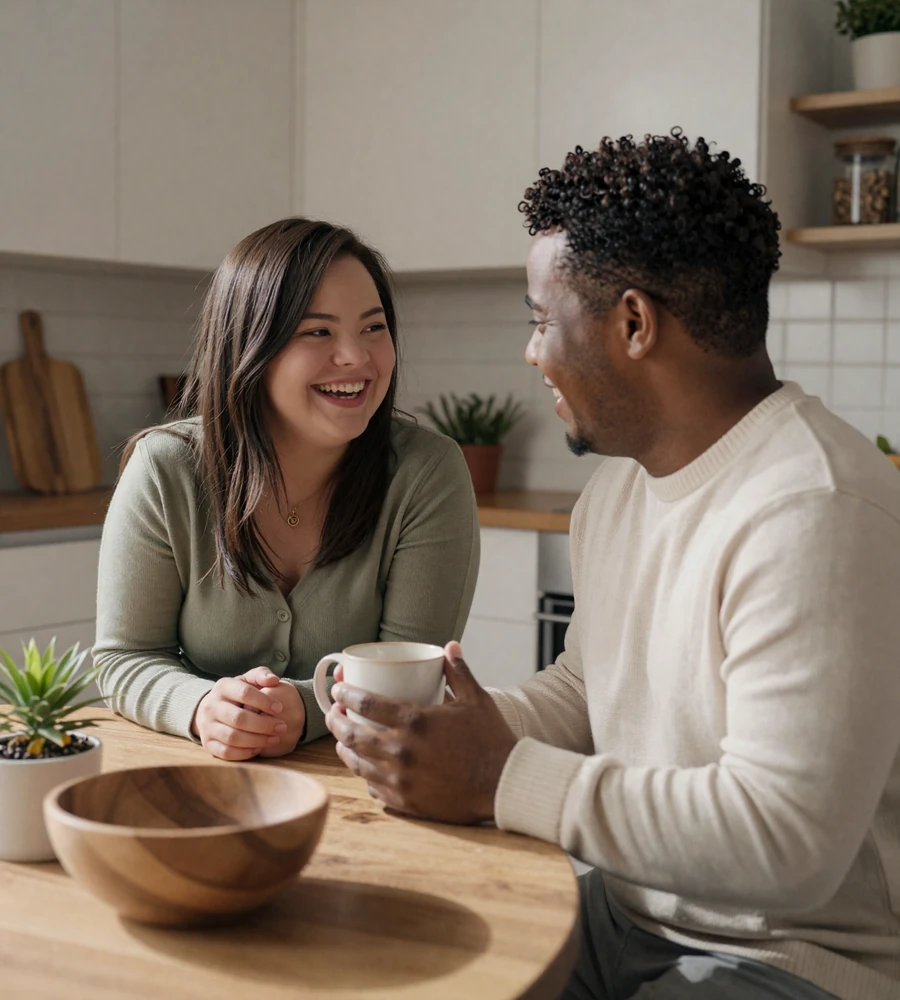
Adults with Down syndrome have every right to date
The most important thing to say on this page, before anything else: adults with Down syndrome are adults. They have the same right to date, kiss, fall in love, move in, and marry as anyone else - and in most U.S. states, the law already reflects that.
The National Down Syndrome Society (NDSS) affirms that teenagers and young adults with Down syndrome are often interested in dating, marriage, and parenthood, and may also want support exploring gender identity and sexual orientation. JustTheTwoOfUs.org, a sexuality education resource written specifically for this community, puts it plainly: people with Down syndrome have the same needs and desires as people without Down syndrome - wanting a boyfriend or girlfriend, wanting physical closeness, wanting to kiss, and, as adults, wanting sex. None of that is controversial among the experts. It only sounds controversial because most of culture has been quietly told otherwise for a long time.
Maryanne Martin and Tommy Pilling, both with Down syndrome, have been married for more than twenty years and living independently for fifteen. The documentary Monica and David and the A&E series Born This Way brought other long-term Down syndrome couples into living rooms across the country. These are not exceptions. They are examples of what happens when adults with Down syndrome are offered the same education, the same freedom to choose, and the same shot at love that everyone else gets by default.
DatingsForum starts from that premise. If you are an adult with Down syndrome, this community is for you. If you are a parent, sibling, carer, or friend reading this on someone else's behalf - welcome too. The rest of this page is written for both audiences.
Down syndrome couples are more common than you think
The data and the lived reality line up: adult romantic partnership is a normal part of life with Down syndrome, and it is growing as independent-living supports expand.
Consent, capacity, and informed choice
Consent is the foundation of every romantic relationship, and it is non-negotiable. For adults with Down syndrome, consent works exactly the same way it works for everyone else: both people have to understand what they are agreeing to, and both people have to actually agree - freely, clearly, and on an ongoing basis.
Capacity is a specific legal and clinical idea, not a diagnosis. U.S. courts assess each person's individual decision-making ability rather than assuming anything from a medical label. Many adults with Down syndrome can consent to dating, sex, and marriage independently. Some benefit from supported decision-making, where a trusted person helps them understand complex choices without making the choices for them. A smaller number may need more formal legal support. The point is: capacity is assessed one person at a time, one decision at a time - never blanket-assumed.
For the partner who does not have Down syndrome, the principle is simple: ask, wait, listen, and believe the answer. If something is unclear, slow down. Enthusiastic "yes," freely given, again and again, is the only green light that counts.
The harmful myth that people with Down syndrome are asexual
One of the most damaging beliefs about Down syndrome is that adults with it are somehow "forever children" who don't want, and shouldn't have, adult romantic or sexual lives. The Down Syndrome Resource Foundation (DSRF) calls this myth actively harmful, because it denies the education, rights, and relationship skills people need to stay safe and happy.
The myth is wrong twice over. First, it is factually wrong - people with Down syndrome experience attraction, crushes, heartbreak, desire, and long-term love like anyone else. Second, it is dangerous: an adult who has been told their whole life that sex is "not for them" is more vulnerable, not less, to boundary violations, because they have been given no language to name what is happening.
Jody Yarborough writes at Love Disabled Life that the asexuality stereotype is one of the most prejudicial beliefs disabled daters face, and often has to be addressed early in a new relationship. Her advice applies here: talk openly and respectfully about bodies, closeness, and sex. Every couple figures out what works for them. A Down syndrome couple is not a different species. They are a couple.
If you want the broader picture across many disabilities, our myths about disability and relationships guide goes through six of them, this one included.
Family support without over-control
Families play a bigger, more visible role in Down syndrome dating than in most other kinds of dating - and that can be a wonderful thing or a quietly suffocating one, depending on how it is handled. The difference is usually the line between supporting and deciding.
Good family support looks like driving to and from a date, helping pick out an outfit, rehearsing how to start a conversation, giving a safety plan, and then stepping back. It looks like welcoming a partner to dinner without grilling them. It looks like parents who have talked honestly about relationships, bodies, and sex since childhood, in small repeated conversations rather than one awkward "talk," and who trust their adult child to use what they learned.
Over-control looks different. It looks like reading every text. Vetoing a partner because of something small. Treating the adult as a child whenever a romantic conversation starts. Assuming a disabled partner is a problem and a non-disabled partner is a predator. These habits are usually born from love and fear, but they tend to produce one of two outcomes: a secretive adult who dates around the family, or an adult who gives up on dating altogether. Neither is the goal.
Parents often worry about driving, employment, parenting capacity, and what-happens-if-it-ends. Those are fair worries and they are worth talking about - with the adult, not over them. Connecting with other families through local Down Syndrome Associations, or with specialists in sexuality education for people with intellectual disabilities, is how most families move from worry to a plan. On the platform side, DatingsForum allows an optional trusted-contact setting that notifies a chosen person when a first in-person meeting is scheduled - a tool for adults who want family in the loop without handing over the keys.
Communication tools for Down syndrome dating
Most dating advice assumes everyone reads subtext at the same speed. For Down syndrome dating - and honestly for most dating - plain, clear, repeated, visual communication works better. Below are the tools daters, partners, and educators in this community use most.
- Short sentences, one idea at a time. "I like you. I want to see you Saturday. Do you want that too?" is better than a long paragraph that has to be parsed twice.
- Picture and visual supports. Picture books, social stories, short role-play videos, and photo schedules of a date ("first the coffee shop, then the park, then home") lower anxiety and raise understanding. JustTheTwoOfUs.org and many Down syndrome associations publish free examples.
- Repeated small conversations, not one big talk. Relationships, consent, bodies, and safety all land better when they come up often, briefly, and over years - not in one dramatic sit-down.
- Rehearsal and role-play. Practicing "how to ask someone out," "how to say no," and "how to ask for help" out loud with a trusted person makes those phrases available in the moment.
- Checking understanding, gently. "Can you tell me back what we just agreed?" is not patronizing when it is mutual - both partners do it for each other. It is covered in more depth in our communication in relationships guide.
- Photos and voice notes in messaging. For daters who find typing slow, voice notes and photos of the day carry real warmth without the friction of a keyboard.
- A shared, simple safety script. One sentence both partners know: "I need to stop." That is the whole sentence. No explanation required, no negotiation after.
Legal and benefits considerations
Two pieces of U.S. reality shape Down syndrome dating more than most people expect: marriage law, and disability benefits. Neither is a reason not to date. Both are reasons to understand the ground before building a life on it.
On the legal side: dating someone with Down syndrome is legal in the U.S. when both partners are of age and can give consent. Adults with Down syndrome have the same right to date and marry as everyone else, though the specifics depend on age, individual capacity, and whether any guardianship is in place. Laws are evolving - many states are moving away from full guardianship toward supported decision-making, which preserves the adult's right to choose a partner. If guardianship paperwork is part of the picture, a disability-rights attorney can explain exactly what it does and does not limit.
On the benefits side: this is where many couples hit an ugly surprise. Marriage can significantly reduce disability benefits. SSI recipients can lose up to 25% of benefits, or all of them, when married; Medicaid and Medicare, which are often tied to SSI, can follow. SSDI itself does not reduce for marriage, but Disabled Adult Child (DAC) benefits - which many adults with Down syndrome receive through a parent's record - stop if the person marries someone who is not also receiving equivalent benefits. Many couples end up facing a painful choice between a legal marriage and keeping the support they rely on for healthcare and daily living.
Recommended platforms for Down syndrome dating
Mainstream dating apps were not designed with Down syndrome adults in mind, and it shows - long written profiles, fast swipe mechanics, dense legal text at sign-up, and very little protection against fetishizers. A good platform for Down syndrome dating looks different.
Look for a dating site that uses plain language, verifies profiles with real humans, explicitly bans devotees and fetish accounts, and lets daters take their time. Look for one that offers photo-heavy and voice-note options, not only long essays. Look for one that welcomes a trusted-contact setting for adults who want family in the loop without giving up their autonomy. Mood tags - calm, funny, home-loving, artsy - give a faster, truer first impression than a 400-word bio.
DatingsForum was built to those standards. It is free to join, open to adults with Down syndrome and to adults without Down syndrome who are genuinely interested in an inclusive community. The same platform serves our autism dating, cerebral palsy dating, and wheelchair dating communities, which means the values - dignity, consent, no devotees, slow pacing - are consistent everywhere. Outside of our platform, local Down Syndrome Associations often host social meetups, adaptive dances, and community events where real couples have met; those are worth plugging into as well.
Related communities
Adjacent guides with overlapping consent, communication, and family-support wisdom.
Autism Dating
Direct communication, sensory-friendly dates, and soft disclosure - plain-language tools that carry over.
Cerebral Palsy Dating
Ask-don't-assume dating, accessible planning, and partnership versus caregiving - with family context acknowledged.
Myths About Disability & Relationships
Six stubborn myths, including the asexuality one, unpacked with evidence and real-world examples.