
Blind and visually impaired dating, conversation-first.
Most dating apps are built around photos, photo swipes, and snap judgements made in under a second. That entire workflow is backwards for blind and low-vision singles - and frankly, it is not doing much for anyone else either. DatingsForum is a blind dating app that opens with voice, description, and the kind of conversation that actually tells you whether you want to meet someone. Free to join, screen-reader tested from the first tap, no devotees, no inspiration narratives.
Free to join · Screen-reader tested · Audio profile bios · Devotee-ban policy
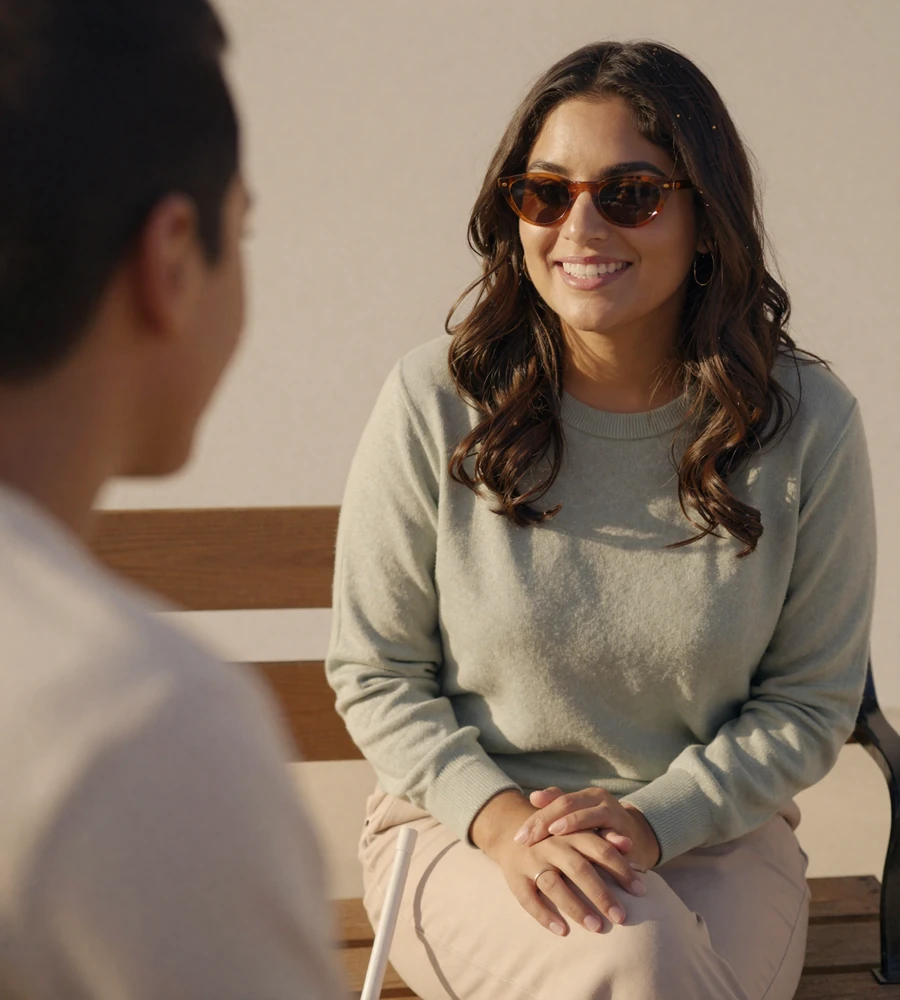
What changes when dating isn't visual-first
More than 7 million Americans live with uncorrected vision loss, and research cited by Includate shows that 82% of visually impaired people successfully build romantic relationships. The barrier is almost never the absence of sight. The barrier is a dating culture that treats sight as the only way to create chemistry - and platforms built on that assumption quietly lock blind and low-vision daters out of the first step.
When dating isn't visual-first, the first impression shifts to voice. Tone, pace, laugh, whether someone listens or just waits to talk - these reveal compatibility faster than any grid of photos. Blind daters often describe the first voice note from a match the way sighted daters describe a first photo: you know within a few seconds whether there is something there. That is not a consolation prize. It is better information, earlier.
Description becomes a shared language. A partner who can narrate a café - "warm wood, two people at the window, the barista is drawing a leaf in your foam" - is practicing the exact attention that makes long-term love work. Blind Me, an accessibility-focused app, deliberately blurs all profile photos at signup and only clarifies them as users interact; the design is an acknowledgment that personality-first matching produces better outcomes for everyone, not only for blind users. Dr. Arielle Silverman of the American Foundation for the Blind puts it plainly: authentic connection is rooted in presence, vulnerability, and communication - not in line of sight.
There is also a quieter shift: the pace slows down. Swipe culture rewards split-second reactions to a face. Conversation-first culture rewards the half-hour it takes to actually learn something about a person. For blind and low-vision daters who have spent years being rejected in 0.3 seconds by an app that never gave their personality a chance, the difference is not subtle - it is the difference between dating and dreading dating.
Screen reader accessible dating platforms
Many mainstream dating apps claim to "support VoiceOver" in the same sentence that they ship an unlabeled image button, a visual-only CAPTCHA, or a swipe gesture with no keyboard equivalent. Claiming accessibility and being accessible are different things, and blind daters learn to tell them apart within thirty seconds of trying to sign up.
Platforms that blind and visually impaired daters report using most include BlindMatch, which builds matching on personality rather than appearance; Dateability, which has invested meaningfully in accessibility and bans "devotees" outright; AbiliMatch, which pairs its platform with a Facebook community where blind members share real dating experiences; and Facebook Dating, which rides on Meta's broader accessibility infrastructure and tends to work more reliably with VoiceOver and TalkBack than Tinder or Hinge. DatingsForum sits alongside these as a general disabled dating site with screen-reader testing baked into every release, not bolted on afterwards.
Disclosing vision loss with confidence
Disclosure is personal, and there is no single correct moment to mention blindness or low vision. The three approaches below all work for different people - the goal is not to pick the "right" one, but to pick the one that lets you date as yourself, on your schedule, with the people you actually want to meet.
The upfront approach. Name vision loss in your profile - a short, matter-of-fact line near the end. "I'm blind, I travel with a white cane, and I'm a very good describer of cheese boards." This filters out anyone who would have ghosted later anyway and tends to attract matches who arrive already curious rather than flustered. APH ConnectCenter advises leading with your identity as a whole person first, so vision loss reads as one true fact among many, not the headline.
The pre-meeting approach. Keep the profile focused on personality, and send a short message before the first in-person date: "Quick logistics - I have low vision, so somewhere with good lighting and a simple layout works best for me. Any of these three spots work for you?" This treats access as shared planning, not a confession, and tends to produce unusually thoughtful replies from the right partners.
The in-conversation approach. Let it come up naturally a few messages in, the same way any other real detail would. "By the way, I use a screen reader, so voice notes are easier for me than long paragraphs - hope that works." Normal, practical, no apology attached. For a deeper look at disclosure timing across different disabilities, our inclusive dating advice guide walks through all three framings with example scripts.
Accessible date venues for blind daters
First-date venue choice matters more for blind and low-vision daters than almost any other planning decision. Familiar, predictable, acoustically gentle spaces let both people focus on each other. Dark bars with music turned to eleven and an unfamiliar floorplan do the opposite. A short shortlist of venues that reliably work:
- Familiar cafés you already know. A place you can navigate without a full cognitive map in your head. You already know the counter, the restroom, the step up to the patio. That saved energy goes straight into the conversation.
- Quiet, well-lit restaurants with simple layouts. Soft background noise (not silent, not loud), steady lighting (no strobes or candlelight-only), tables spaced far enough apart that you can hear your date without leaning across the salt. Call ahead and ask to be seated somewhere calm.
- Audio-described cinema screenings. Most AMC and Regal locations in the U.S. support Audio Description via in-ear devices; independent theaters increasingly do too. A shared story with narration baked in - an unusually good second or third date.
- Museums with tactile or sensory tours. Many American museums run tactile tours by appointment and are ADA-required to be physically accessible; the Metropolitan Museum of Art, the Smithsonian institutions, and the Art Institute of Chicago all run recurring programs. Conversation flows easily, and you don't have to fill every silence yourself.
- Walks on familiar routes - guide dog welcome. A park you know, a boardwalk with a railing, a neighborhood loop with even pavement. Walking side-by-side is less face-pressure than sitting across a table and makes room for pauses. If you travel with a guide dog, say so when proposing the date, not after you arrive.
- Home cooking or takeout at yours or theirs (once trust is built). For later dates, not first ones. Predictable environment, no background roar, and the kind of small shared task - chopping, plating, pouring - that builds intimacy faster than a third round of small talk.
- Live music in small, seated venues. Jazz clubs, acoustic sets, poetry readings. Sound-led experiences you can enjoy fully, with none of the pressure to "look at" anything together.
For a broader look at planning accessible dates across mobility, sensory, and energy needs, see our accessibility in dating guide.
Safety for blind daters
A national survey found that 88% of disabled dating app users have experienced some form of app-facilitated sexual violence, and Norton's 2025 Cyber Safety Insights Report found that 40% of dating app users have been targeted by scams. Blind and low-vision daters face an additional wrinkle: it is harder to independently verify a stranger's face, location, and behavior in real time. These aren't reasons not to date - they are reasons to build a short, non-negotiable safety routine you run every time.
-
Tell a trusted friend the plan
Name, photo (sighted friends can reverse-image-search for you), venue, arrival time, and when you expect to be home. A simple check-in text at the start and end is low effort and worth everything. Our online dating safety guide has ready-to-send scripts.
-
Meet first in a location you already know
A familiar café, a regular restaurant, a park bench you can find with your eyes closed. Familiarity removes an entire category of stress and puts you in charge of the pace. Save the new place for the third or fourth date, when trust is earned.
-
Arrange your own transport both ways
Arrive independently - rideshare, paratransit, a friend's drop-off, public transit you already use. Leave the same way. Do not accept a ride home from someone you just met, even if they are being kind about it. Independent transport is not rudeness; it is the thing keeping your options open.
-
Video or voice call before meeting in person
A 10-minute voice or video call before the first meeting catches catfishing, confirms the person sounds like their messages, and gives you a real-world sense of pace. Verified voice says more about a person than any verified photo could.
-
Keep personal information on a slow release
Home address, workplace, exact route to and from - none of these belong in early conversations. Use a secondary email for dating accounts, keep your phone number for after the first in-person meeting, and don't share your location in real time with anyone you haven't met.
-
Trust the "something is off" feeling
If a match pushes back when you mention vision loss, asks uncomfortable questions about your body, offers unsolicited "help" that feels more like control, or pressures you to meet somewhere private first - block and move on. Our safety & privacy page covers the devotee-ban policy and the in-app reporting flow in detail.
Dating a blind person: partner etiquette
If you are sighted and dating a blind or low-vision partner, you do not need to become an expert in vision loss to be a great match. You need a handful of small habits that, done consistently, communicate respect and make the relationship easier on both sides. None of this is complicated.
-
Identify yourself when you speak
Walk up to a blind partner in public and say "Hey, it's me" before the rest of the sentence. Group settings: name who you are and, where helpful, who just joined or left the room. It prevents the disorienting experience of a disembodied voice guessing at identity.
-
Describe the environment when it matters
Not a running audiobook of every object - that's exhausting. A sentence when you arrive at a restaurant: "We're at a booth against the back wall, window on your left, table is a two-top." A sentence when something changes: "The server just put your glass at two o'clock." Concise, useful, warm.
-
Offer your arm, never grab
In unfamiliar spaces, say "Would you like my arm?" and let them take your elbow. They then walk a half-step behind, using your body as a guide. Grabbing a blind person's arm, shoulder, or cane to "steer" them is disorienting, unsafe, and surprisingly common. Ask first, every time.
-
Don't touch the cane or the guide dog without asking
The white cane is a mobility tool and a personal extension. The guide dog is working - not a pet while the harness is on. Ask before petting, and don't assume you're being helpful by "moving the cane out of the way."
-
Say when you're leaving the room
Talking to an empty chair because a partner walked away silently is a small humiliation nobody needs. "I'm heading to the kitchen, back in a minute" takes a second and removes it entirely.
-
Let your partner do the things they can do
Ordering their own food, pouring their own drink, navigating their own route on a familiar street. Stepping in uninvited, however kindly meant, can read as infantilizing. If you're unsure whether to help, ask - and then trust the answer.
Best blind dating app options
There is no single best blind dating app for every person, but a short, honest shortlist helps. Dedicated accessibility-first platforms - BlindMatch, Dateability, AbiliMatch, Hiki (autism-focused but strong on accessibility), and DatingsForum - prioritize screen-reader usability, non-visual verification, and moderation against fetishization from day one. They tend to have smaller pools than Tinder, but the pool is already pre-filtered for people who understand disability and are showing up on purpose.
Among mainstream apps, Facebook Dating generally performs best with VoiceOver and TalkBack because it inherits Meta's broader accessibility work. Bumble and Hinge are middle-of-the-road - usable, not elegant. Tinder is technically compatible but famously friction-heavy for screen reader users, with unlabeled buttons and swipe-dependent core actions. If you choose a mainstream app, expect to do real work on behalf of the company's missing accessibility; on a dedicated platform, that work has already been done for you.
The best sign that a dating app actually cares about blind daters is not a marketing page titled "Accessibility." It is whether the signup flow works on the first try with VoiceOver, whether the verification system has a non-visual option, and whether the moderation team bans devotees on sight. DatingsForum is built to clear all three bars, and the free tier is the free tier - no surprise paywall in front of the messaging.
Related communities
Adjacent guides covering sensory disability, neurodivergent communication, and accessible date planning.
Deaf Community Dating
The parallel sensory-dating experience: ASL and Deaf culture, communication method disclosure, caption-friendly video chat, quiet well-lit venues.
Autism Dating
Direct, literal communication and sensory-aware date planning - helpful overlap with how many blind daters prefer to talk.
Accessibility in Dating
The full first-date accessibility checklist - physical, sensory, and emotional - with venue categories that work across disabilities.