
Dating with cerebral palsy - the full spectrum of CP love.
Cerebral palsy is not one thing, and neither is dating with it. Some of our members walk into the cafe without anyone noticing CP at all. Others roll in with a power chair and a speech-generating device, already typing their first joke. DatingsForum is a free disabled dating site built for every point on that spectrum - and for the partners who want to meet them as people, not as projects.
Free to join · AAC-friendly chat · Interabled community · Screen-reader tested
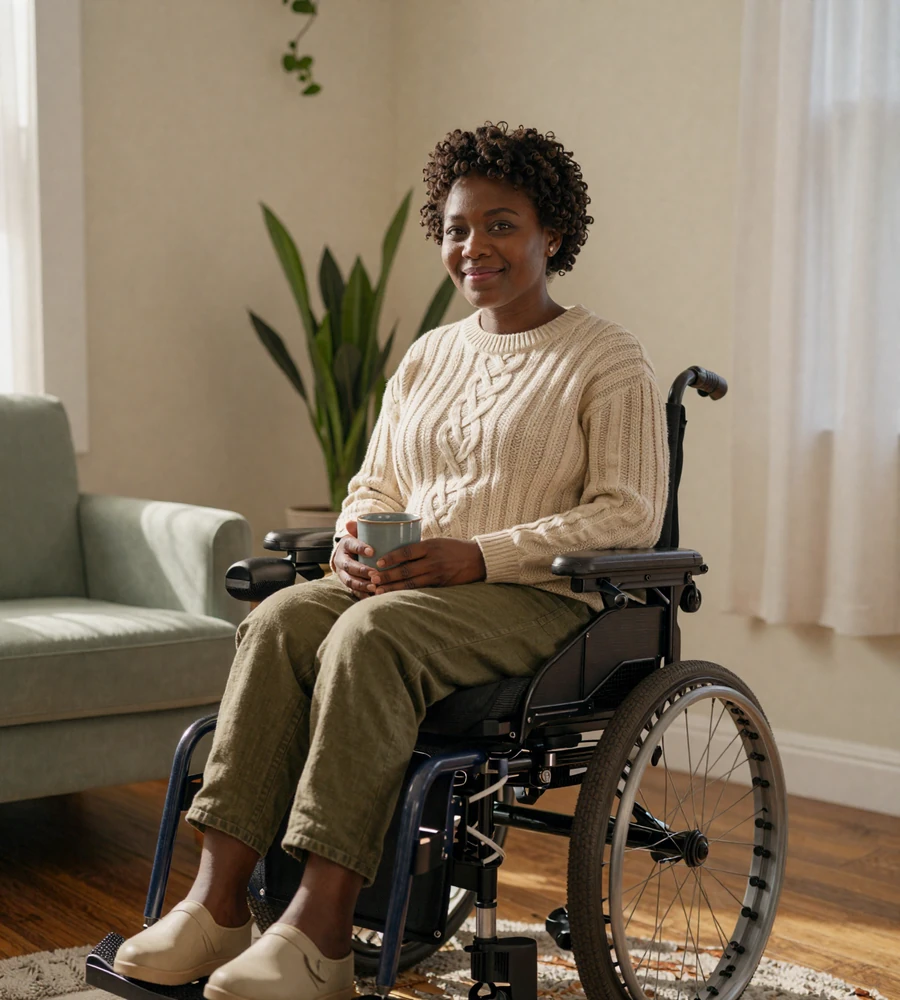
Every CP presentation looks different
Cerebral palsy is an umbrella term for a group of movement conditions caused by brain injury before, during, or shortly after birth. It affects muscle tone, coordination, and motor control - and it is wildly non-uniform. Two people with the same diagnosis can live in bodies that do almost completely different things.
One DatingsForum member walks unaided, works as a software engineer, and only mentions CP when a new partner asks about the slight drag in her left hand. Another uses a power chair full-time, communicates with a combination of speech and an AAC app, and employs a part-time personal assistant for morning routines. A third has hemiplegic CP on his right side, plays adaptive tennis twice a week, and describes his dating profile as "limps a little, flirts a lot." All three are accurate representations of cerebral palsy. None of them is the definitive one.
That spectrum matters for dating because generic CP advice - including well-meaning articles from organizations that should know better - tends to collapse the whole range into the most visible, most motor-involved presentation. A date who has read one article about CP and arrives expecting to cut your food, translate your speech, and push your chair is a date who has prepared for the wrong person. The research from the CP Transition Study of Southwest Netherlands, which followed young adults with CP over four years, found that 71% of participants had dating experience and 23% were in a current romantic relationship - lower than non-disabled peers, but vastly higher than the stereotype of CP as an impediment to romance suggests. Women with CP, interestingly, were significantly more likely than men to be in current relationships across the study.
The takeaway for partners: do not prepare for CP in the abstract. Prepare for the person sitting across from you, whose body, speech, energy, and support needs are theirs specifically and not transferable from any article, including this one.
Ask, don't assume - the foundation principle
If there is one rule that holds across every CP relationship on this platform, it is this: ask, then listen, then act on what you actually heard. Cerebral palsy varies so much that the only reliable source on what a specific person needs is that specific person. Everything else is guessing with good intentions, which is still guessing.
"Ask, don't assume" also runs in the other direction. As a CP dater, you are not obligated to perform stoicism. If something hurts today, say so. If a venue is going to be a problem, say so before you get there. Partners cannot adjust to information they do not have, and most of them genuinely want the information - they just do not know how to ask for it without sounding like they are auditioning for a sainthood.
Communication tools including AAC
Speech is affected by CP in roughly one in four cases, and the range is enormous - from a slight articulation difference that a new partner adjusts to in a week, to dysarthria that benefits from an AAC (augmentative and alternative communication) device. DatingsForum is built so that how you talk does not dictate whether you can date.
- Text-first chat with no time pressure. Every conversation on the platform can be carried in text for as long as both people want. There is no "now you must video." Typing at your own pace, with an AAC app, or with voice-to-text is all the same thing on our end: a message arriving when it arrives.
- AAC device friendliness. Whether you use Proloquo2Go, TouchChat, a dedicated Tobii Dynavox, or a custom rig on an iPad, your messages come through normally. We do not penalize slower typing or flag AAC-pattern language as suspicious.
- Video with captions and a patience setting. When you move to video, captions are on by default. A partner adjusting to your speech in the first few calls is normal - dysarthria becomes dramatically easier to parse after two or three conversations, the same way any unfamiliar voice does.
- Speech-to-text, text-to-speech, either direction. Some members prefer to type and have their message read aloud to the partner. Others prefer to speak and let the app caption. Both work. Both are communication.
- Naming your method in your profile. A short line - "I use AAC for long conversations and speech for short ones" or "My articulation is easier to understand in text for the first week or two" - takes the guesswork out and attracts partners who have already decided this is fine.
- Scheduled pauses instead of interruptions. For partners who speak quickly, the single most generous shift is leaving three or four seconds of silence after a question. That is not awkward; that is space for an answer that was always going to arrive, just not on a non-disabled tempo.
- Repair, not rescue. If a partner misses a word, the useful move is "can you say that part again?" - not pretending to understand. Pretending to understand is the most common relationship injury in CP dating, and it is avoidable.
Accessible date planning with CP
A well-planned date with a CP partner is not a different kind of date. It is a normal date with a few variables confirmed in advance - the same way you would check whether a restaurant takes reservations. The full accessibility guide covers the general principles; this list focuses on the CP-specific ones.
-
Call the venue, don't trust the website
"Accessible" on a website can mean ADA-compliant step-free access, or it can mean "only one small step at the entrance, which most people manage fine." Call ahead. Ask specifically about the entrance, the table height, the bathroom, and the route from the parking area. Museums in the U.S. are a reliable default - ADA-mandated, often with loaner mobility aids, and built for conversation.
-
Respect the fatigue curve
Many people with CP spend more energy on routine movement than non-disabled people do. A three-hour dinner after an already full day is a different proposition than it looks from the outside. Shorter first dates - a coffee, an hour in a bookshop, a quiet park bench - let a CP partner arrive with energy still in reserve for actually being charming.
-
Mind the temperature
Cold can stiffen CP-affected muscles and warm weather can trigger spasticity fluctuations. A patio date in a Chicago January is not romantic; it is a physiotherapy appointment with candles. Ask about temperature preferences the same way you would ask about food allergies.
-
Pick speech-friendly acoustics
Loud bars are hard for everyone. For a partner with dysarthria or a partner learning to parse dysarthria, they are genuinely disqualifying. Quiet restaurants, bookshops, garden cafes, and daytime venues all dramatically improve the odds that the conversation is the conversation you meant to have.
-
Plan the seat before the reservation
A booth with a fixed bench can be impossible to transfer into. A high top with bar stools can be the same. Request a standard chair with arms, at a normal table, on an end with room for a mobility aid. Most restaurants can absolutely do this - if you ask when booking rather than on arrival.
-
Build in a graceful exit
A date that can end at sixty minutes if energy runs out, and continue for three hours if it does not, is a successful design. "Let's meet for a coffee and see where the afternoon takes us" beats "I've booked us a seven-course tasting menu" for every first-to-third date with a CP partner.
Partnership vs caregiving - holding the line
An interabled couple is one in which one partner has a different ability level from the other, and the defining challenge of that relationship is not the disability - it is resisting the cultural pull to collapse the partnership into a caregiver-and-patient dynamic. CP couples get this pressure heavily, because CP is visible, because caregiving imagery is widely available, and because most people outside the relationship quietly assume the non-disabled partner is doing something heroic.
They are not. They are in a relationship. The distinction between partnership and caregiving is not about what gets done - plenty of partnership tasks look, from the outside, like care. Helping with a coat in a cold lobby. Cutting food occasionally when hands are tired. Massaging a cramping calf on a movie night. Reserving the accessible seat on a train. The distinction is about the frame: who decides, who leads, whose life this is. In a partnership, the disabled partner is the protagonist of their own life and the decision-maker about their own body, and practical help is logistics, not virtue. In a caregiver dynamic, those same tasks stop being shared logistics and start being favors granted by the non-disabled partner, with gratitude implicitly owed.
Signs the frame is slipping the wrong way, for either partner to watch for: the non-disabled partner answers questions meant for the CP partner; the CP partner apologizes for existing in their own body; decisions about time, money, and plans drift to one side unilaterally; the relationship starts being described to outsiders as "I look after her" or "he's wonderful to put up with me." None of those sentences belong in a real partnership, and all of them are common. Catching them early and reframing - out loud, specifically - is one of the most important long-term skills in CP dating.
Professional personal-care support matters here too. A CP partner who has part-time paid support, family support, or community support for the most physically taxing tasks is a partner who can show up to the relationship as a partner, not as a job. If the only person in the picture who can help is the romantic partner, the partnership will bend toward caregiving whether anyone wants it to or not. Protecting the partnership sometimes means making sure there are other hands available for the non-romantic parts of daily life.
Confidence in CP dating
Internalized ableism is the absorbed belief that a CP body is less desirable, less dateable, less entitled to joy - and almost every CP adult who grew up in a non-CP world is carrying some of it, even the ones who appear confident. The UP Adult Cerebral Palsy Movement names low self-esteem and body image issues as one of the top dating barriers for CP adults, often preceding any external rejection at all.
That internal weather affects dating long before a profile is written. It shows up as hesitating to post the photo with the walker. Writing a bio that lists CP last, or leaves it out, or buries it in a euphemism. Swiping only on people who seem "nice enough to probably not mind." Assuming that any match is either a devotee or a pity click. None of those patterns are laziness. They are a nervous system trying to protect itself from a decade of small rejections.
The shift is not "just be confident." It is reframing the story. Disability advocate Nathasha Alvarez puts it simply: "Your disability does not define you, but it is a significant aspect of your life. By owning your story, you take control of the narrative." On a profile, that looks like leading with what you love - your work, your art, your dog, your sharp sense of humor - and naming CP as one real, neutral fact among many, instead of as a disclosure that requires apologizing. Emily Goodson's 2025 book Dating Disability: 15 Stories of Dealing with the BS and Building Confidence is a useful companion text for exactly this reframe, and our confidence and self-acceptance guide walks through the practical daily version.
The community piece matters too. Talking to other CP adults who are dating, partnered, raising kids, getting divorced and dating again - all the ordinary arcs - quietly destroys the idea that CP is an exit from the normal human experience of love. It isn't. It never was. The story that said it was was wrong.
Intimacy considerations for CP couples
Sex with CP works. That is the headline, and most of the culture still has not caught up to it. The 2017 Springer study on sexual behavior of young people with cerebral palsy found that sexual self-esteem and sexual needs correlated strongly with dating experience, cuddling, and intimacy milestones - which is the clinical way of saying: CP adults who believe they are allowed to want sex have more of it, and better. Belief is the first move.
The practical considerations are straightforward and entirely adaptable. Pacing matters more than choreography - CP-affected muscles fatigue faster under sustained effort, and slower sex is usually better sex anyway. Positioning is a collaborative project; side-lying, supported positions with pillows, and seated options are often more comfortable than the textbook ones, and talking through what works is part of the fun rather than a clinical interruption. Temperature and warm-up both help - a warm room and a few minutes of gentle touch or massage before more active sex can reduce spasticity and cramping significantly.
Adaptive intimacy aids exist and are worth knowing about. Products like the IntimateRider - a chair originally designed by a quadriplegic - are built specifically for couples with mobility differences and cover paraplegic sex, spinal cord injury intimacy, and adjacent territory that applies cleanly to many CP bodies. Wedges, supportive pillows, and grab handles are inexpensive and underrated. A prescribing doctor or pelvic-floor physiotherapist who understands CP can help with specifics - including medication interactions, catheter considerations for some members, and positioning around hip tightness or scissoring.
The conversational side is the biggest lever. "Slower there." "Not that angle today." "Can we try on the other side?" These are not mood-killers; they are the grammar of good sex with any body, and CP bodies happen to require it sooner in the relationship than non-CP bodies do. Couples who get used to talking during sex end up with better sex - and, quietly, better relationships - than couples who do not. CP just fast-forwards that skill.
One last note: you are allowed to want this. You are allowed to expect it. A partner who finds CP intimacy inconvenient, embarrassing, or off-putting is not a partner for you - they are a partner for someone else, if anyone. DatingsForum exists so you can meet the ones who do not need to be talked into it.
Related communities
Adjacent guides with overlapping mobility, energy, and interabled wisdom.
Wheelchair Dating
Chair etiquette, eye-level conversation, accessible venue scouting, and profile photos that show the chair without apologizing.
Amputee Dating
Disclosure timing, prosthesis-visible profile photos, confidence building, and partners who meet you as a whole person.
Epilepsy Dating
Disclosure scripts, seizure first-aid for partners, venue planning around triggers, and the stigma conversation.